

“Dead time lasts for one hour—from half an hour before midnight to half an hour after midnight. The half hour before midnight is for doin’ good. The half hour after midnight is for doin’ evil… We goin’ to the flower garden.”
— Minerva, character in John Berendt’s Midnight in the Garden of Good and Evil
Featuring massive, glowing white trumpet-shaped flowers, Datura wrightii, commonly known as Jimsonweed, unfurls its beauty only under the cover of darkness and remains open until past morning’s twilight. It carries a rich cultural legacy in America, spanning ancient spiritual traditions to contemporary artistic movements. Yet, for all its cultural weight, the plant evokes sharply polarized opinions: to some, a lethal, malevolent toxin to be feared; to others, a symbol of beauty, art, and spiritual power.
The Darker Side of the Nightshade Family
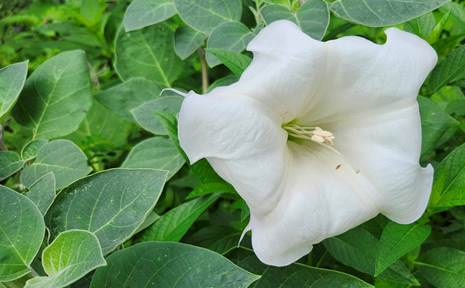
Datura wrightii’s long list of common names illustrates its split personality. The angelic, revered aspects of the plant are represented by Angel Trumpet, Sacred Datura, and Sacred Thorn-apple. Conversely, the lethal dangers within the plant are borne out in menacing names, such as Devil’s Apple, Devil’s Trumpet, and Locoweed. Few native plants in the American landscape carry monikers that so perfectly divide the line between the sacred and the sinister, the literal ‘good and evil’ within a single species.
This striking wild specimen is a member of the Solanaceae family, better known as the Nightshades. It is a lineage with strange contradictions, containing many popular agricultural crops, such as potatoes, tomatoes, peppers, and tobacco. But Jimsonweed, like other species in the family, carries strong toxic defense mechanisms that define the darker side of the lineage.
Even the etymology of Datura is unusual, stemming not from Greek or Latin, but an early Sanskrit word meaning “divine inebriation”. The species is named for Charles Wright, 1811-1885, a worldwide botanical collector, who focused on Texas, Cuba, and his native Connecticut. Jimsonweed is a corruption of “Jamestown Weed“, tracing back to a famous 1676 incident when starving British soldiers in Jamestown, Virginia accidentally consumed one of its non-native sister species (Datura stramonium) and suffered wild, incapacitating delusions for 11 days.
Built for the Night
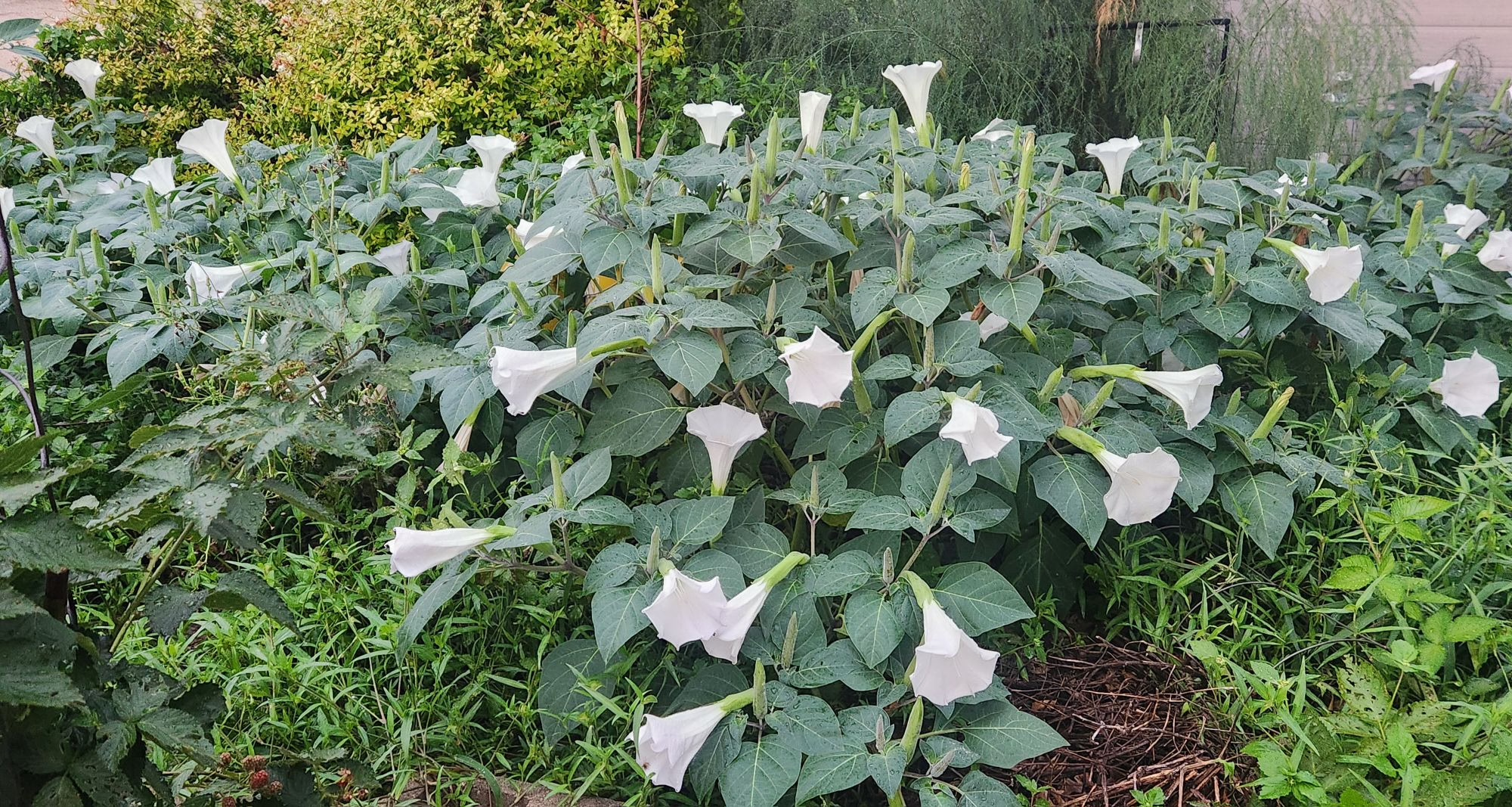
Jimsonweed has an unmistakable appearance, with large mounds of velvety grayish-green leaves and the star of their night-time cabaret: large white trumpet-shaped flowers.
- Foliage: The distinct leaves are large, broadly oval, and covered in fine, short hairs. It often reaches 3 feet in height and spreads to 3-6 feet.
- Blooms: These show-stopping blossoms can stretch up to 8 inches long and 6 inches wide. When viewed in the morning’s twilight, the massive petals take on a warm pearly glow. They typically bloom from late spring to early autumn.
- Moon-lit Partnership: Unlike most native wildflowers that attract daylight pollinators, Datura is strictly crepuscular and nocturnal. This nighttime schedule is designed specifically to attract the Carolina Sphinx Moth (Manduca sexta). These large, hovering insects possess long proboscises perfectly adapted for the heavy nectar pooled deep within the flower’s throat.
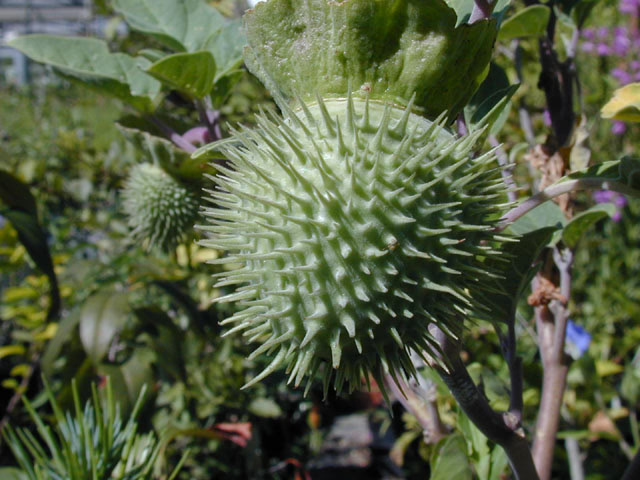
- Fruit: After pollination is complete, the flower gives way to a spherical, thorny fruit capsule roughly the size of a golf ball. This “thorn-apple” opens when mature, revealing hundreds of flat, tan seeds.
- Lifespan: It behaves as a short-lived perennial in southern climates, dying back completely to its thick, fleshy taproot after hard freezes and returning to life in the spring. While in the north, it acts as a true annual, dying off completely and returning only from dropped seeds.
In the Wild and in the Landscape
- Native Range: Jimsonweed is an exceptionally hardy native, now widespread across the United States. But its pre-European distribution stretched only from California across Arizona, New Mexico, and Texas.
- Native Habitats: Highly adaptable in the wild, this resilient survivor can exist in varied environments, including arid soils, highway rights-of-way, and well-drained flood plains.
- Landscapes: For native plant enthusiasts looking to incorporate Jimsonweed into a native landscape, its cultivation needs are practically non-existent. For a plant of the night, it thrives in full sun but can exist quite well in partial shade. It is very drought-tolerant, relying on its deep taproot to store water.
- Caution: If you bring them into your landscape, be sure to avoid planting in areas with children or pets.
Ritual and Representation
All parts of Datura wrightii – the roots, leaves, seeds, and nectar – contain a potent cocktail of chemicals. These chemicals gave the plant a revered place in Native American history. Many cultures in the Southwest and along the Pacific Coast, including the Chumash, Hopi, Tongva, and Zuni, utilized highly controlled preparations of the root in sacred rites of passage, vision quests, and divinatory practices.
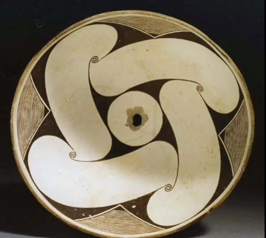
Native cultures’ ceremonial relationship with the plant inspired a rich legacy of indigenous artwork, interpreting sacred visionary experiences into creative expressions. In the Lower Pecos region of southwest Texas, Archaic-period pictographs depict motifs of the Jimsonweed. Later, in the 10th–12th centuries, the Mimbres culture in southern New Mexico took this visual legacy further. On their signature black-and-white pottery, they painted spiraling designs that reflected the blossom’s unfurling.
A Cultural Dichotomy
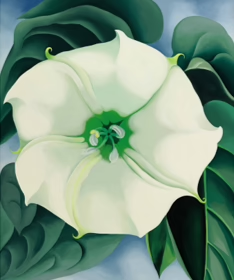
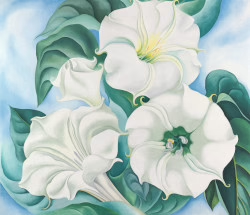
Jimsonweed’s dramatic aesthetic, toxins, and night-blooming have intrigued modern artists, writers, and musicians. One of its most famous admirers was the American painter Georgia O’Keeffe. Fond of the white trumpet-like blossoms that grew wild around her home in northern New Mexico, O’Keeffe immortalized the plant in several of her iconic, highly magnified floral close-ups. The delicate blooms stood out to her as one of the most overlooked forms of natural beauty, an object the modern world ignored. She made it her mission to highlight their complex structures, explaining:
“When you take a flower in your hand and really look at it, it’s your world for the moment. I want to give that world to someone else. Most people in the city rush around so, they have no time to look at a flower. I want them to see it whether they want to or not.”
Her 1932 painting, Jimson Weed/White Flower No. 1, broke records when it was auctioned for $44 million in 2014, taking this humble roadside plant into the highest echelons of contemporary American art.
Other artists, especially singers and songwriters, have also been entranced by Jimsonweed. This includes the well-known Cowboy ballad, “The Streets of Laredo”. In one of the countless variations on this song, which dates back to 18th-century Ireland and Britain, is a variant first recorded by Harry Jackson in 1960:
Well, I was born in Southeast Texas,
Where the jimson weed and the lilac does bloom;
I went to go live there for to go far a-ranging,
And I’ve trailed from Canady down to old Mexico.
— Harry Jackson’s Variant of “Streets of Laredo”
Jackson learned this specific variant while working on ranches in Montana and Wyoming in the late 1930s. It is an unsanitized variant of the ballad, as many popular versions of the song omitted the Jimsonweed reference as well as mentions of brothels and saloons. The juxtaposition of the toxic Jimsonweed growing alongside the benign “lilacs” is a metaphor for the beauty of the range, coexisting with the fatal dangers inherent in the environment. In this context, “lilac” was likely another flowering shrub, and was informally referred to as a lilac because of the cultivated plant’s familiarity.
A slight variation of the song was done by folk singer Slaid Cleeves for the album, ‘Dark River: Songs of the Civil War Era: Interpretations by Austin’s Finest Musicians’. He substituted the word “blow” for “bloom”, an archaic use of the term that goes back to the 11th century.
An Enduring Enigma
Much like the eccentric, dual-natured characters of John Berendt’s famous novel, Jimsonweed refuses to be easily categorized. Its mix of beauty, danger, and nocturnal allure has become deeply embedded in American culture. This enigma of the twilight has entranced people for eons and will likely continue to attract and mystify for generations to come.
