News and Events

News and announcements from our committee chairs, board members, and chapter leaders. Subscribe to our mailing list to stay up to date. For chapter news, visit Chapters. If you are looking for a calendar of events, see our Events Calendar.

  • Chapter or Committee

Bastrop

November 2024 Plant of the Month

This month, we’re celebrating Verbesina virginica, better known as Frostweed! With its delicate white blooms that attract butterflies and bees in the fall, Frostweed also showcases a winter wonder- beautiful “frost flowers” that form at its base during the first freeze, turning local landscapes into a magical winter scene. Why

Read More »
Bastrop

October 2024 Plant of the Month

Say hello to Frogfruit (Phyla nodiflora), October’s featured native plant! This low-growing perennial is more than just a ground cover- it’s a pollinator powerhouse! With its tiny white flowers, Frogfruit attracts butterflies, bees, and other beneficial insects, making it a must-have for any Texas garden. Plus, it’s drought-tolerant and thrives

Read More »
Photo of Shelby Green
Big Bend

Scholarship Awards: 2024 Patty Manning Scholarships

Patricia Rose Manning 2024 Undergraduate Scholarship Awards The Big Bend Chapter of the Native Plant Society of Texas Scholarship Committee is excited to announce our 2024 Patricia Rose Manning Undergraduate Scholarship Recipients. The committee is currently comprised of four society members from our chapter and is led by the scholarship

Read More »
Lakes and Pines

Dec. 4: Celebrating Lakes & Pines 2024 Inaugural Year!

All Lakes and Pines Chapter members are invited to join us for our Members’ Board Election & Holiday Social at Sorelle Farms, 2:00 – 3:30pm, December 4. We will be celebrating the holidays and our first year as a chapter.  Members are asked to bring a favorite appetizer or sweet to

Read More »
New Braunfels

An Ecologic overview of growing native plants & using sound environmental practices

The basics on the connection between growing natives, practicing sound environmental principles and how this affects ecosystem health.
Craig Hensley is a lifelong naturalist, biologist and educator, having shared his passion for the natural world with audiences from Minnesota to Nebraska, Iowa, Kansas, Missouri, and for the past 13+ years, in Texas. He served as the Interpreter and Resources Specialist for Guadalupe River State Park and Honey Creek State Natural Area, as a Wildlife Biologist for Comal and Kendall Counties, and for the past 4+ years as one of two Texas Nature Trackers Biologists with the Community Stewardship and Engagement Program. Craig lives with his wife Terry Lashley in Boerne where he has grown more than 70 species of native plants in his small greenhouse, converting their yard to a nature sanctuary.

Read More »
Trees in winter landcsape
State

No-Freeze Trees

Are your trees ready for winter? While most established native trees have developed natural mechanisms to tolerate cold, young and newly-planted trees may need some protection, according to Mac Martin, a Texas A&M Forest Service Urban Forester. Here are some tips to help your trees survive the cold this season:

Read More »
Boerne

Boerne Chapter Holiday Potluck Supper December 3

Join us in celebrating the holiday season with our traditional December Pot Luck Supper on Tuesday, Dec 3 at 6 pm, at the Hunke Gathering Hall at Herff Farm. The Board will provide the main meat dish. Please bring a side-dish or dessert to share with the group.  As always,

Read More »
Boerne

Fall Native Plant Sale

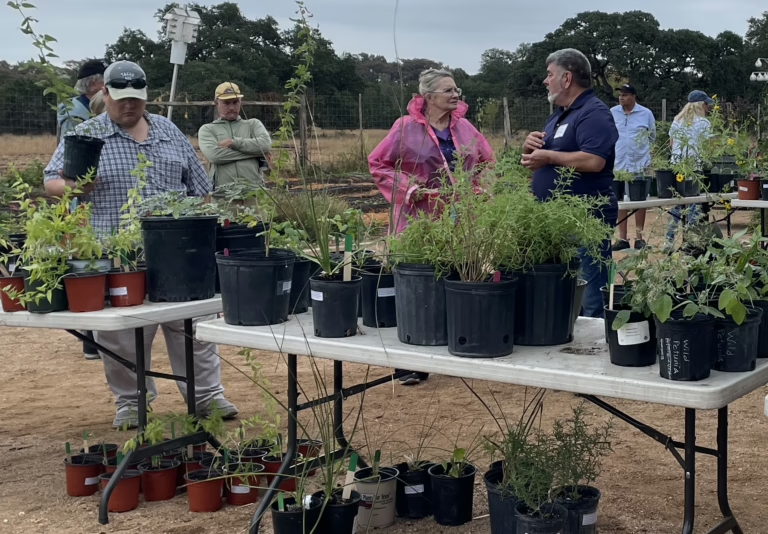
The Boerne Chapter of the Native Plant Society of Texas had another successful plant sale on October 19!  There were over 750 plants and a record-breaking 107 different native plant species provided by our 24 chapter member growers. Despite some early morning drizzle, the community and members came out to

Read More »
Highland Lakes

Native Landscapes for Birds Class – Nov 2, 2024

Highland Lakes Chapter hosted Native Landscaping with Birds class on Saturday, November 2, 2024 at Inks Dam National Fish Hatchery. Twenty three people attended this class with some people coming from as far as DFW, Houston, and the Rio Grande Valley. Kay Zagst, an avid birder, presented the Class Topic

Read More »

November Newsletter Now Available

Our chapter’s November newsletter is now available, click on image to be redirected. If you would like to be added to our email listing, please send a note to collincountynpsot@gmail.com.

Read More »

About the Region

Fall Symposium 2025 Logo - Teach for the Future

Salado, the location of our Fall 2025 Symposium, lies at the intersection of two ecoregions: the Edwards Plateau (Limestone Cut Plain) and Blackland Prairie (Northern Blackland Prairie).

The Edwards Plateau area is also called the Hill Country; however, this general term covers a much larger area extending farther north. Spring-fed creeks are found throughout the region; deep limestone canyons, rivers, and lakes (reservoirs) are common. Ashe juniper is perhaps the most common woody species found throughout the region. Additional woody species include various species of oak, with live oak (Quercus fusiformis) being the most common. Sycamores (Platanus occidentalis) and bald cypress (Taxodium distichum) border waterways. This area is well known for its spring wildflower displays, though they may be viewed in spring, late summer, and fall, as well. According to Texas Parks and Wildlife, average annual rainfall in the Edwards Plateau ranges from 15 to 34 inches.

The Blackland Prairie extends from the Red River south to San Antonio, bordered on the west by the Edwards Plateau and the Cross Timbers, and on the east by the Post Oak Savannah. Annual rainfall averages 30 to 40 inches, with higher averages to the east. This region is dominated by prairie species. The most common grass species include little bluestem (Schizachyrium scoparium) and Indian grass (Sorghastrum nutans) in the uplands and switchgrass (Panicum virgatum) in the riparian areas and drainages. Common herbaceous flowering plants include salvias, penstemons, and silphiums. This area has suffered greatly from overgrazing and agricultural use. Few intact areas remain, though many of the plants can be found along county roadsides throughout the region.

Our fall Symposium host chapter, the Tonkawa Chapter, includes both of these ecoregions.

Source: Wildflowers of Texas by Michael Eason