Clear Lake Chapter

Plant of the Month: Frostweed

Presented by Meade LeBlanc
March 11, 2024

Botanical name: Verbesina virginica
Common name(s): Frostweed, White Crownbeard, Iceplant, Iceweed, Virginia Crownbeard, others
Family: Asteraceae


[MUSIC—EASY AND FUN]

[Meade] This month’s plant of the month is Frostweed, or Verbesina virginica. Common names for Verbesina virginica include Frostweed, White Crownbeard, Iceplant, Iceweed, Virginia Crownbeard, Indian Tobacco, Richweed, and Squawweed. This plant is part of the aster family.

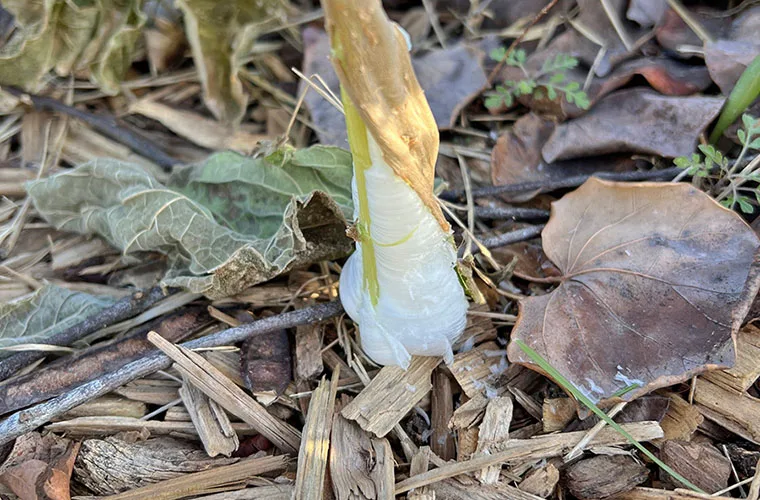
Why is it called Frostweed? When temperatures go below freezing, the stems exude water that freezes into interesting shapes. And the ice crystals have been given many names as well. Ice ribbons, ice flowers, ice fringes, ice fingers, ice filaments, ice leaves, frost flowers, frost ribbons, frost freaks, frost beards, and frost castles.

The map on the right shows the native distribution — from Pennsylvania to Texas and south to Florida. It’s considered a perennial or a biennial, and a biennual is a plant that takes two years to complete the flowering cycle. Typically, it grows vegetatively the first year and flowers and fruits during the second year. It’s an herb (silent H) or herb (pronounced H), a plant species that lacks woody tissues when mature. It’s also deciduous, meaning the leaves will fall off at the end of the growing season. The size is listed to up to eight feet tall but it’s often shorter. And it’s certainly shorter than that in my yard, reaching about four feet. The leaves are dark green. The flower heads are three to six inches across. The bloom color is white and it blooms from July to December.

There are a couple different ways to propagate Frostweed. The first one is to divide the roots while they’re dormant in winter. The second one is to collect some seeds: Allow the seedheads to dry on the plants and then remove them and collect them. At the bottom right that’s what that photo is. It uses low to medium water and it thrives in part shade and shade. The soil moisture is dry to moist. It’s very easy to grow and it can form sizable colonies with spreading rhizomes. And again, based on my yard, it does tend to spread on its own.

The benefits of Frostweed include attracting butterflies, it’s resistant to deer, it has a special value to native bees, and it’s fun to watch in the winter. If it goes below freezing, be sure and take a look at any Frostweed you have in your yard.

Thank you.

[MUSIC—AND THAT’S IT]

Related Posts

Frostweed

Frostweed Puts on a Winter Show

Frostweed by Meade LeBlanc—If you had Frostweed in your garden, you might have noticed a show a couple of weeks ago during the freezing weather.

In praise of weeds

Is there a more scornful word in the botanical universe than “weed?” We’re trained from early childhood to dislike anything associated with the term. Because of that, we native plant lovers and promoters have work cut out for us when striving to educate.

About the Region

Fall Symposium 2025 Logo - Teach for the Future

Salado, the location of our Fall 2025 Symposium, lies at the intersection of two ecoregions: the Edwards Plateau (Limestone Cut Plain) and Blackland Prairie (Northern Blackland Prairie).

The Edwards Plateau area is also called the Hill Country; however, this general term covers a much larger area extending farther north. Spring-fed creeks are found throughout the region; deep limestone canyons, rivers, and lakes (reservoirs) are common. Ashe juniper is perhaps the most common woody species found throughout the region. Additional woody species include various species of oak, with live oak (Quercus fusiformis) being the most common. Sycamores (Platanus occidentalis) and bald cypress (Taxodium distichum) border waterways. This area is well known for its spring wildflower displays, though they may be viewed in spring, late summer, and fall, as well. According to Texas Parks and Wildlife, average annual rainfall in the Edwards Plateau ranges from 15 to 34 inches.

The Blackland Prairie extends from the Red River south to San Antonio, bordered on the west by the Edwards Plateau and the Cross Timbers, and on the east by the Post Oak Savannah. Annual rainfall averages 30 to 40 inches, with higher averages to the east. This region is dominated by prairie species. The most common grass species include little bluestem (Schizachyrium scoparium) and Indian grass (Sorghastrum nutans) in the uplands and switchgrass (Panicum virgatum) in the riparian areas and drainages. Common herbaceous flowering plants include salvias, penstemons, and silphiums. This area has suffered greatly from overgrazing and agricultural use. Few intact areas remain, though many of the plants can be found along county roadsides throughout the region.

Our fall Symposium host chapter, the Tonkawa Chapter, includes both of these ecoregions.

Source: Wildflowers of Texas by Michael Eason