Presented by Nancy Saint
August 14, 2023
Botanical name: Andropogon ternarius
Common name(s): Splitbeard Bluestem, Split Bluestem, Feather Bluestem, Paintbrush Bluestem, Silvery Beardgrass
Family: Poaceae
[MUSIC—EASY AND FUN]
[Nancy] Plant of the month for August is Splitbeard Bluestem, Andropogon ternarius, and also called Feather Bluestem or Paintbrush Bluestem.
It is a native. It’s a warm season grass. It’s a perennial. It’s a bunchgrass. By warm season, it means that it’s dormant in the winter and starts growing in the spring as the weather warms up. A bunchgrass tends to stay in a small circle or a bunch. The grass has numerous thin basal leaves, which usually stay about 12 or 15 inches tall, which makes it ideal in our home landscapes. It grows best in part shade to full sun. And this grass will be available at our plant sale on October 20 and 21.
It prefers to grow in sand or well-drained soil, which we kind of struggle with here, but it does do well. It’s shade tolerant and drought tolerant. I know the camera has a hard time focusing on those light hairy little seeds.
The bloom time is from August to November. In late summer, it will send up its bloom stalk, which may be up to three feet tall. And, as the seeds on the long slender stalk mature, they’ll split into two tiny stems about two inches long, each with seeds of fluffy white tufts. The seeds are wind distributed.
The plants may be started from seed or another way is to dig your mature plant and with your shovels, cut it into maybe four sections, which then can be replanted in other places in your yard or shared with some of your neighbors. It’s an easy plant to grow.
Splitbeard can be found on the prairie with Little Bluestem and it’s great when it’s seen in the afternoon sun en masse; reminds me of snowflakes on the branches. And it can be used in a winter dried arrangement in the house.
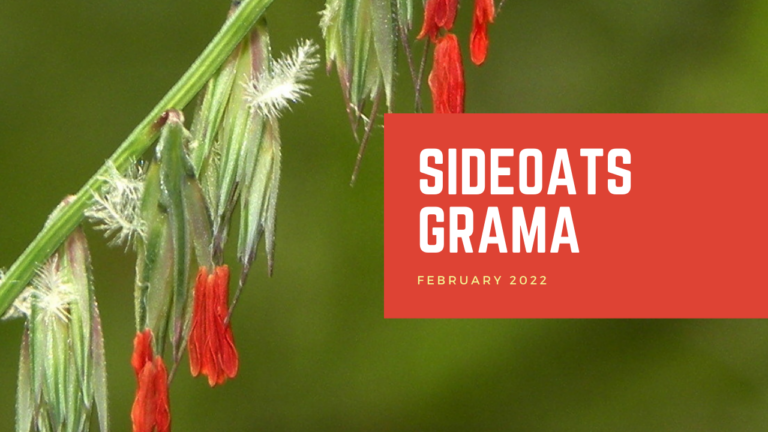
Native bees can use Splitbeard Bluestem for nesting materials. And until their bloom stalk is sent up, the narrow basal leaves are hard to distinguish from other bunchgrasses such as Sideoats Grama.
And there it is. And you note how the seeds are all on one side, thus its name. We don’t have any of this one for sale at our fall sale. Maybe we will in the spring, in April.
But it was interesting, I thought, when I looked for Splitbeard Bluestem in the Wasowski book of Native Texas Plants these two bunchgrasses were on the same page. So, that is the story of the Sideoats Grama and the Splitbeard Bluestem.
Thank you.
[MUSIC—AND THAT’S IT]