Home » Collin County » Preserving the Resilience of Native Prairies with Prescribed Burns
Collin County Chapter
Preserving the Resilience of Native Prairies with Prescribed Burns
Tim Castelli
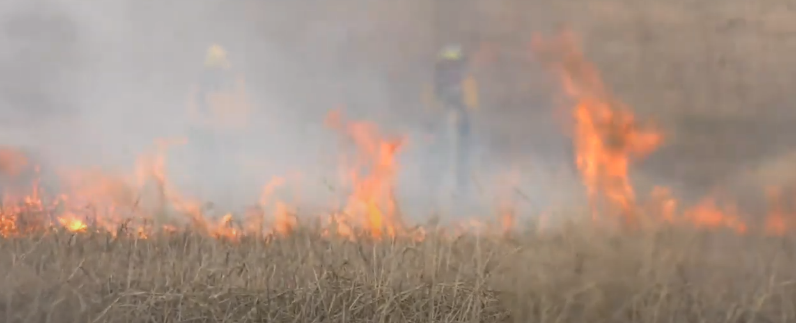
Recently the city of Plano undertook a prescribed burn, a controlled fire intended to provide a natural “cleansing”, in portions of the Oak Point Park and Nature Preserve. The objective was to help encourage growth in the native prairie, and reduce invasive grass species, woody plants, and thatch.
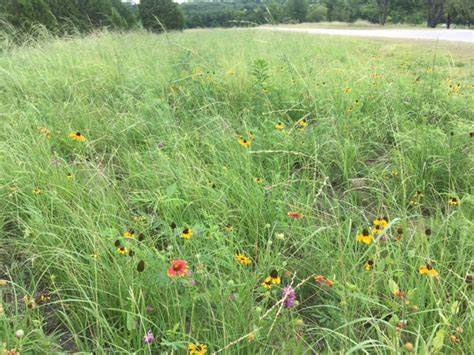
Prescribed burns, when carefully controlled and timed, help to maintain or return the land to its natural and diverse state. Our native tallgrass prairies are made up of grasses, wildflowers, and other non-woody plants. Native prairies have great resilience, whether surviving brutal cold snaps, extended droughts, or prolonged drenching downpours. It takes tough plants to weather our North Central Texas extremes.
The burns benefit our environment through:
Increasing biodiversity of the prairie by reducing invasive plants.
Clearing of thatch and other material enables more exposure to the sun, and water to nurture prairie plants.
Reinvigorating soil nutrients through recycling of the burned plant material.
Improving water quality and reducing runoff by enhancing the land’s ability to store more water.
Native prairies for eons had nature’s help through natural wildfires created by lightning to dispatch trees and shrubs, and the build-up of thatch. But since early European settlers, grass fires have been suppressed, so trees and shrubs began to invade the prairie. In addition, non-native invasive plants have wreaked havoc with the prairie ecosystem.
Controlled fires of prairies and other ecosystems had been a common practice among Native Americans. Indigenous tribes had used burns for thousands of years to manage habitats for a variety of benefits to their community. They recognized the need to control fires to better manage their surroundings.
In Collin County, going back thousands of years, prairie fires have burned every 3 – 10 years. They are a critical linchpin of our Blackland Prairie ecoregion. The fires do not harm native prairie plants and wildlife. In fact, they provide the grasses and other plants with the signal to grow.
The Blackland Prairie Raptor Center (BPRC) in Allen has recently also been conducting prescribed burns in parts of their preserve to restore a native tallgrass prairie. They did the first burn in 2020 and have more planned for 2021. We talked with Lorelei Stierlen, Treasurer of the Collin County Chapter of the Native Plant Society of Texas, and the Administrator of the BPRC’s native prairie restoration:
Q: What is the history of the prairie at the BPRC?
Lorelei: The land has gone through three significant changes over millennia, and we are working hard to take it
Courtesy of Blackland Prairie Raptor Center
back to its first stage – native tallgrass prairie. We can tell the site’s origins by the presence of Vertisol clay, typically found in that type of prairie.
When European settlers first came to the site in the nineteenth century, they developed ranches, not agriculture. The clue for this is the presence of large dormant native seed beds. If it had been developed for agriculture usage, tilling would have destroyed the beds.
Next, the Army Corps of Engineers took over the land to create Lake Lavon. They made major modifications to the land for drainage and park development.
Lastly is the change we are working on currently, restoring the land back to its original state.
Q: Was there reluctance to do controlled burns?
Lorelei: Yes, there were some concerns and reticence about performing the burns. There were assorted reasons cited: risk of the fire getting out of control, the proximity of houses, bureaucratic hoops, and the cost. However, by working closely with the US Army Corps of Engineers and their burn boss, we gathered the approvals to proceed.
Q: What were the primary reasons for implementing a burn program?
Lorelei: The primary objective of the burns was driving out the non-native King Ranch (KR) Bluestem. The KR was a popular livestock forage, but thankfully it is not a particularly hardy non-native. The shallow roots are severely damaged by the burns. Eliminating the KR opens the soil for Little Bluestem (Schizachyrium scoparium), and other native grasses and wildflowers.
Q: Even though it has been a relatively short time frame, what are the early results from the 2020 burns?
Lorelei: In a word, it has been “transformative”. This past fall is when the native grasses really took center stage. The fire kick-started the grasses because they exhibit a strong growth response to fire. Burning makes them happy.
Also, there is a misconception that fire kills the non-native perennial grasses – it does not. But because some non-natives, like KR, do not have a vigorous recovery mechanism from fire and shallow roots, they are not as resilient to fire.
The native’s deep roots and recovery mechanism from fire generate vigorous growth, which is what we saw after the 2020 burn. Little Bluestem really shines in late fall and early winter. It is the anchor, both figuratively and literally, of the tallgrass prairie.
Q: What do you see in the future for controlled burns at the BPRC?
Photo Courtesy of Lorelei Stierlen
Lorelei: Broadly speaking, it will be three to five years between burns. But there are different intervals and times of the year required to achieve distinct objectives. Key variables in calculating the timing between burns include the strength of existing natives versus non-natives, and the type of plant we want to encourage – native perennial grass, perennial wildflower, or annual.
After burning over 17 acres in 2020, our next scheduled burn is later this month. We are burning six acres on the north side of the property. Then we will take a break in 2022 and resume the burns in 2023.
The prescribed burns in Plano and Allen were done with a significant amount of planning by city fire departments, and other agencies, along with communication to neighboring homeowners. Some of the other steps included mowing around the edges of the burn area, fire department personnel with hoses circling the site, and pre-treating some of the perimeters with water.
More information about the BPRC burn is available here.
About the Region
This low-elevations region of Texas extends inland from the barrier islands, about 60 or so miles, and stretches from Brownsville to Louisiana. In total, it covers about 9.5 million acres, with a high point of 150 feet in elevation. More than 1000 species of plants can be found in this region. On the southern end, species more common in Mexico (such as Sabal mexicana) and Central America occur.
The barrier islands provide us with dune systems, and clay flats to the inland side, which have species found in these areas alone. Many plants here, such as Ipomoea pes-caprae (beach morning glory), can be found throughout tropical regions of the globe. I’ve encountered the same species on the beaches of Guam.
Once inland, vast marshes and wet prairies occur. Occasionally, oak (Quercus fusiformis) groves can be found. Common grasses include species of Bothriochloa, Paspalum, and Sporobolus; eastern gamagrass (Tripsacum dactyloides); and switchgrass (Panicum species). Many rivers and creeks cut through the Gulf Prairies, and along these riparian areas various species of trees, Sabal minor, and other plants adapted to clay soils can be found. Due to overgrazing, farming, and fire suppression, woody species such as mesquite (Prosopis glandulosa) and huisache (Acacia farnesiana), and invasive species such as chinaberry (Melia azedarach), Brazilian pepper (Schinus terebinthifolius), and Chinese tallow (Sapium sebiferum) have increased and displaced our native flora.