Provided courtesy of the Trinity Forks Chapter and Dr. Becca Dickstein
Description:
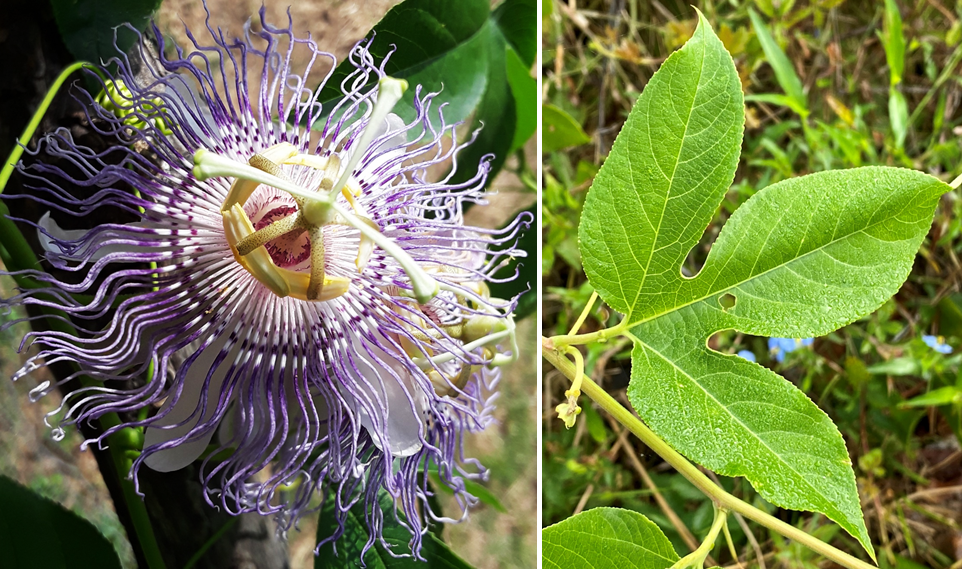
Passiflora incarnata L. is commonly known as Purple Passionflower or Maypop. It is a perennial vine reaching 12-36 ft in height, with glossy, dark-green tri-lobed leaves. In North Texas, expect Passionflower to die back to the ground each winter and sprout from the ground each spring.
Flowers and Seeds:
Purple Passionflower has showy flowers. Blooms are lavender to purple, about five to six inches across, and quite distinctive. Following flowering, three-inch yellow-orange fruit form that have edible pulp. After these dry, seed may be harvested. The blooming season starts in May/June and continues until frost. The genus Passiflora and common names for P. incarnata L. come from its flowers and fruit. The floral parts were said to represent parts of the Christian crucifixion, with the ten petal-like parts representing disciples of Jesus and the other floral parts representing other aspects of the Christian story. Interestingly, Maypop refers to the fruits that pop when crushed.
Planting sites:
Purple Passionflower thrives in partial shade to full sun in a range of soil pH and soil types. It also prefers dry to somewhat moist sites and must be well-drained. It should be planted on or near a structure on which it can climb.
Watering Instructions:
Water Purple Passionflower well when planting it or its seed. It is drought tolerant except in severe dry spells.
Comments:
Purple Passionflower is a must-have for the butterfly garden. It is the preferred larval host for the larva of the Gulf Fritillary butterfly, a three-inch across bright orange butterfly. In a good season, the larva can completely defoliate a Purple Passionflower plant, but don’t worry – the leaves will grow back to support more larva. For this reason, it’s also a great plant for a children’s garden, where children can observe the butterfly larva grow, pupate and undergo metamorphosis to become butterflies.
Purple Passionflower is also a larval host for the Red-banded Hairstreak, Banded Hairstreak, and Variegated Fritillary butterflies. Purple Passionflower is easy to confuse with some of its non-native cousins. Look for the three-lobed leaf shape as an identifier of this particular Passionflower. Passionflowers can spread extensively by root suckers. It is somewhat deer resistant. Consider growing Purple Passionflower instead of invasive non-natives like Japanese Honeysuckle (Lonicera japonica) or one of the exotic Wisteria species (Wisteria floribunda or W. sinensis).
Lastly, seek out the NICE Plant of the Season signs and information sheets on your next visit to a participating North Texas nursery.