We continue our retrospective on timeless articles from The Coneflower Courier, our chapter’s paper newsletter from 1994 – 2001. This time it is on Trout Lilies (Erythronium albidum), a seldom seen plant that makes its annual appearance at the Heard Museum in late winter or early spring.
The January 1994 article was written by Harold E. Laughlin, Ph.D., who was the Heard Museum’s Wildlife Sanctuary Director. If you are fortunate to find one of these rare gems at the Heard, please only look, do not pick, so the Trout Lilies last for another 30 years and beyond. Enjoy.

You may know these beautiful little harbingers of spring by another name – Dog-tooth Violet and Johnny jump-ups, are the most frequently seen or heard synonyms. They are not violets of course, and the flowers do not look anything like the members of that family. Trout Lilies and Wood Violets (Viola sororia) both bloom early in the spring in much the same habitats, and perhaps the misnomer comes from that association.
Naming Confusion
Dr. Harold Rickett in his monumental multi-volume, “Wildflowers of the US” says that the original European “Dog-tooth Violet” has a red flower more similar to a typical violet color (Erythronium means red) and that is the source of the confusion. He also says that the “dog-tooth” is the little white pointed bulb underground, but the bulb is covered with the brown scaly sheath, and I have heard elsewhere that part of the name comes from the curved white pointed tepals.
Johnny Jump-up is a pretty good name for these popper-uppers, but that name is more properly applied to Viola rafinesquei, also called Field Pansy, and other similarly fast-growing plants in various parts of the country.
Trout-colored Leaves
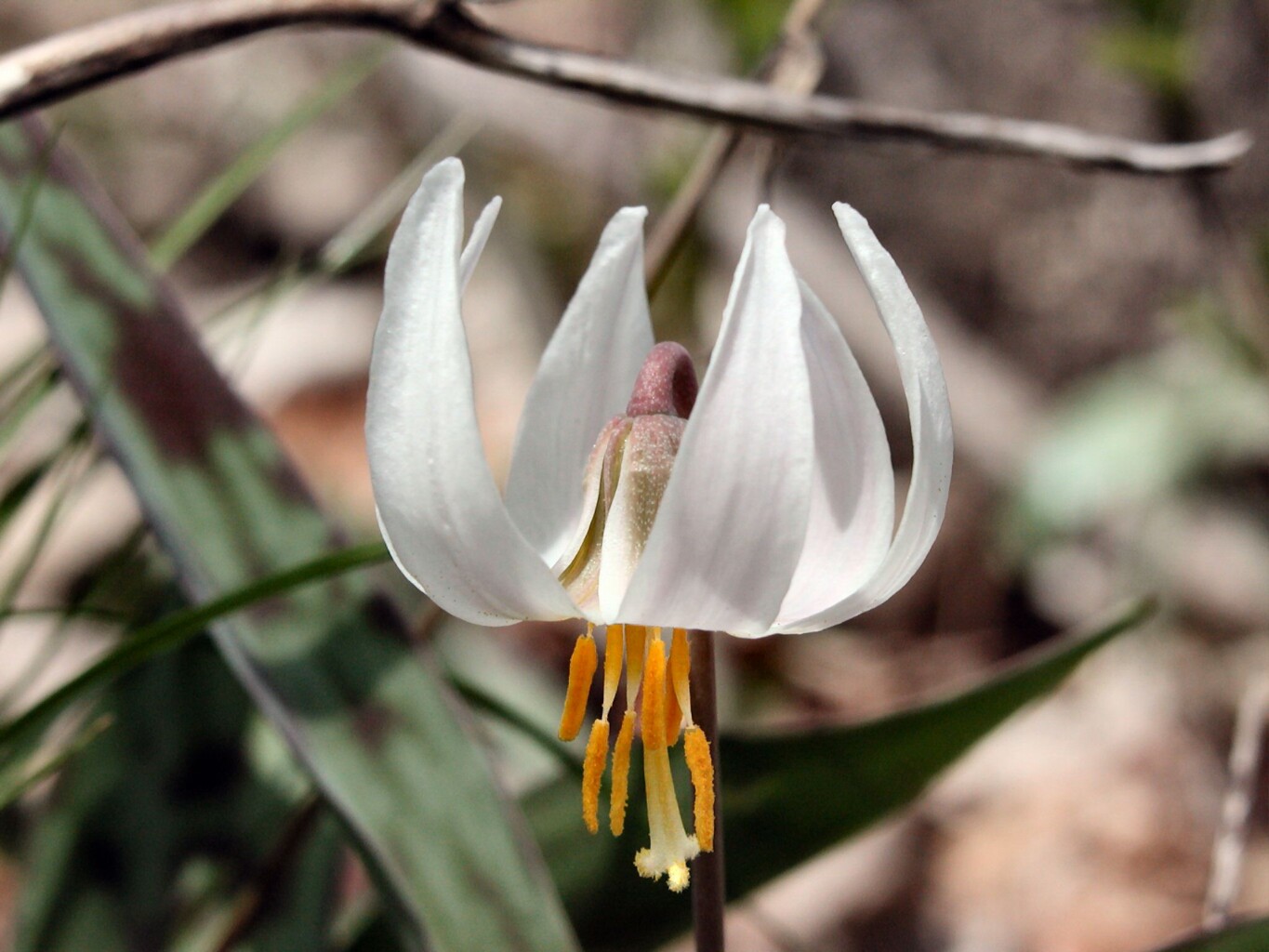
Erythronium albidum is definitely in the Lily (Liliaceae) family, with six floral segments, a three-chambered fruit, and a deep, scaly bulb. The two smooth, shiny dark green leaves are mottled with light-green and purplish-brown, suggesting the back of a mottled trout, hence the preferred name. The tepals (basically similar sepals and petals) are narrowly lance-shaped, white with pink, blue or lavender on the backside, positioned at the tip of a single stalk. The stalk usually bends downward at the tip so that the flower hangs down, facing the ground.
Trout Lily Habitat
Typical habitat for Trout Lilies is moist, densely-wooded hillsides, often above a stream or pond. I can remember them in my private yard in Tulsa where I grew up.
They do bloom very early in the spring, mostly during March but frequently by the end of February, usually well ahead of the typical early “yard weeds” like henbit, crow-poison, chickweed, et al. At the Heard we always know spring is imminent when the Trout Lilies bloom.
The genius Erythronium is widespread across the continent. Erythronium albidum ranges from Ontario and Minnesota, south to Georgia, Kentucky, Missouri, and Northeast Texas. A yellow-flowered relative Erythronium rostratum, grows from East Texas eastward and northward to Alabama, Tennessee, Missouri, and Kansas.
One of my favorite areas of the country is Western Washington, in the Cascade and Olympic Mountains, where White Avalanche Lilies (Erythronium montanum) and Yellow Glacier Lilies (Erythronium grandflorum) are found.
Rooster-fights
The late Mrs. Ruth Weeks, one of the early teachers at the Heard, and donor of most of the specimens in the Rock & Mineral Hall, used to tell a story about another colloquial name for the Trout Lily. She recalled that, as a girl, she and one or another of her childhood chums would each pick a stem of Trout Lily. Holding each stem by the base, they would hook the downward-bent flowers together and pull. The weaker of the two stems would break off, leaving the “winner” to be challenged by another picked stem. From the game, the flowers were given the name “Rooster-fights”.
I’ve never heard of that name from any other source, so I presume it was strictly local. That is just as well, we do not need any more common names to add to the confusion.
Dr. Harold Laughlin
Wildlife Sanctuary Director
Heard Natural Science Museum and Wildlife Sanctuary