

This tough, host plant with unique samaras is more than an “informal” understory tree.
Ptelea trifoliata is one of those native plants that at first glance is easy to misunderstand. One of its common names is Wafer Ash, but it is not a true ash. The other popular common name is Hop Tree, but its ‘hops’ are actually flat, papery seeds called samaras. Additionally, because it has small flowers and an informal shape, it is easy to overlook. But this native has a lot to offer, including distinctive fruit, adaptability, and a host plant for swallowtail butterflies.
Form, Foliage, and Flexibility
The Wafer Ash’s form can be a large shrub, a small tree, or a bit of both, and is amenable to pruning. Often reaching 20 feet tall, it has an irregular, generally rounded form. The leaves are trifoliate, meaning each leaf is divided into three leaflets, a feature reflected in the species name trifoliata. In the landscape, Wafer Ash works especially well at the woodland edge, in wildscaping, or in a less-than-formal native garden.

Photo courtesy of the Wildflower Center and Joseph Marcus.
Growing Conditions
Similar to the Clove Currant (Ribes aureum var. villosum) discussed in an earlier article, the Hop Tree can tolerate a range of conditions:
- Both sun and part shade
- Varying moisture levels
- Variety of soil types
But with a caveat – it needs good drainage. This need is clearly demonstrated in its natural distribution. In the wild, it is often found in open woods, thickets, ravines, and rocky slopes, typically in the understory.
Native Range
Hop Trees have a broad native range in the United States, covering the eastern Great Lakes region, west into Iowa and Kansas, and then south into an area ranging from Texas to Florida. This wide swath highlights its flexibility rather than preference for narrowly specific conditions.
The Citrus Secret
One of the more interesting facts about Ptelea trifoliata is that it belongs to the Rutaceae (Rue or Citrus) family. Crushing the leaves yields a slight citrusy-like scent. It is the northernmost species in the Rutaceae family. That citrus-family connection also plays an important role ecologically. Plants in Rutaceae are larval hosts for certain swallowtail butterflies.
Flowers and Fruit
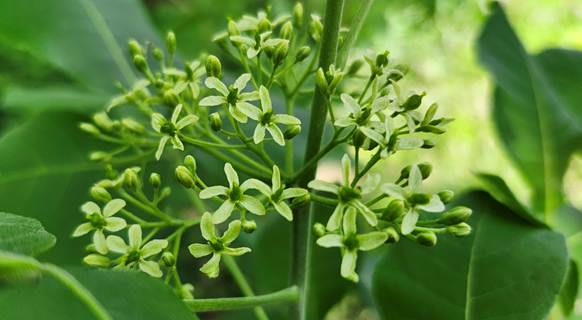
Wafer Ash flowers are small, greenish-white to yellow, and grow in clusters. With their subtle color, they may not be as showy as a Texas Redbud (Cercis canadensis var. texensis) or a Mexican Buckeye (Ungnadia speciosa), but they do provide understated color to landscapes. Individual trees are either male or female, so the females produce the characteristic wafer-like seeds.
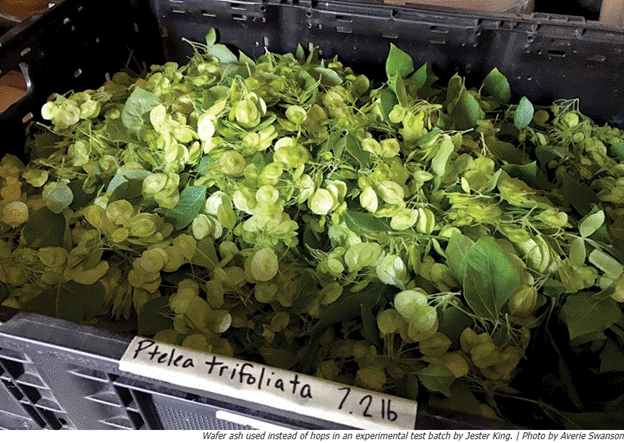
The fruit, technically an achene, on the other hand, is especially distinctive and unique. It produces flat, round, winged samaras that are thin and papery, providing the origin of the common name “Wafer Ash.” These disk-like fruits often last long enough to be one of the plant’s most recognizable ornamental features. The Wafer Ash’s samara has the seed in the middle of the wing, preventing it from having the aerodynamic qualities of other samara-producing plants with the seed on one side.
The origin of the other well-known common name, Hop Tree, is also tied to the fruit. Early European pioneers used the fruit as a substitute for hops in brewing. But there is no documentation that it was ever used by commercial brewers, only by homebrewers. More recently, an Austin-based brewery experimented with using the Hop Tree fruit, but was not happy with the results, and ended the project.
Not a True Ash
Despite its common name, Wafer Ash is not a true ash in the genus Fraxinus. In many parts of the US, this is an important distinction because true ashes are the hosts of the emerald ash borer. While the name may imply vulnerability, Wafer Ash is not a host of the invasive insect.
A Nursery for Swallowtails
Beyond its botanical and ornamental interest, Wafer Ash is an important wildlife plant. It serves as a larval host for both the Eastern Tiger Swallowtail and the Giant Swallowtail. A butterfly garden needs to be more than just nectar plants; host plants are critical in helping support the caterpillar stage, such as Ptelea trifoliata.
A Native Overachiever
Wafer Ash is a native small tree / large shrub that does not rely on a single dramatic season. But it combines foliage, flowers, fruit, and wildlife value. Together with its toughness and adaptability, it is a native plant with far more to offer than its modest reputation suggests.
